If your business re-imports goods that were previously exported, or temporarily brings goods into the EU or UK for an event, project, or demonstration, you might be paying more customs duties and VAT than you should.
Returned Goods Relief (RGR) and Temporary Admission (TA) are two procedures designed to solve exactly that problem. They help you avoid duty payments, manage temporary imports efficiently, and bring clarity to one of the trickiest areas of customs: returns and temporary movements.
This article draws from insights shared during our Special Procedures Webinar on RGR & TA. It’s written for customs managers, logistics professionals, and finance leaders who want to better understand how these two complementary procedures can deliver financial, operational, and compliance benefits.
TL;DR: Why RGR & TA Matter
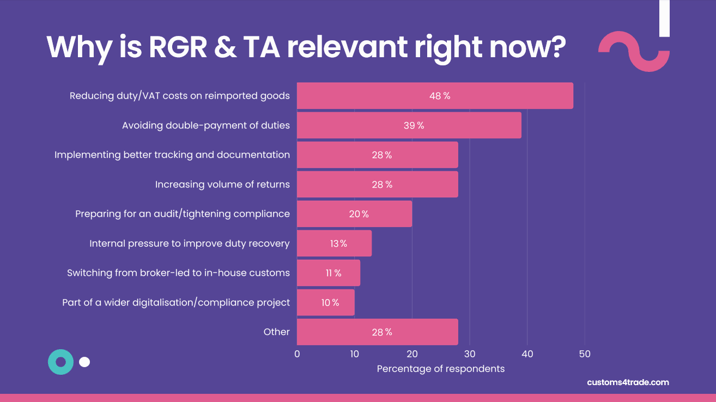
When we asked webinar attendees why they were interested in RGR and TA, the responses were telling:
- 48% said their main goal was reducing duty and VAT costs on re-imports.
- Nearly 40% said they wanted to avoid paying duties, a common risk when paperwork isn’t watertight.
- Around 25% cited documentation and tracking challenges, especially as return volumes rise in e-commerce.
- 20% pointed to audit readiness and compliance as key motivators.
Taken together, the picture is clear:
Businesses want to save money, stay compliant, and stay in control.
For many, these procedures are not just about cost recovery, they are about ensuring customs operations can stand up to audit scrutiny while keeping customers and internal teams confident that processes are watertight.
When we ran a live poll, 27% of respondents said they already use both RGR and TA, 44% said they don’t use either, and 20% are in the process of implementing one. However, there is still plenty of room for improvement and opportunity.
What is Returned Goods Relief (RGR)?
Returned Goods Relief allows you to reimport goods into the EU or UK without paying customs duties or VAT, as long as those goods were originally exported from the same customs territory and come back in the same state.
Imagine exporting laptops from France to Canada, but the customer cancels the order. The goods are returned to France within three years, unchanged. Under RGR, you can reimport them duty-free.
To qualify, several key conditions must be met:
- The goods must have been Union goods (or goods produced under Inward Processing) when exported.
- They must return within three years of export (though extensions can apply in special cases).
- The goods must be identical and in the same state; repairs or maintenance are fine, but transformation isn’t.
- You must be able to prove they are the same goods, usually through the original export declaration or an INF3 certificate if the goods return to a different EU country.
- The exporter and importer must be the same entity to qualify for VAT relief.
In practice:
- Export the goods as normal.
- When they return, explicitly request RGR on the import declaration, customs will not apply it automatically.
- If the goods return to a different member state, use an INF3 document to support your claim.
Documentation is everything. The stronger your audit trail, the smoother your RGR process will be.
What is Temporary Admission (TA)?
While RGR covers goods leaving and later returning, Temporary Admission works the other way around: it lets you temporarily import goods into the EU or UK without paying duties or VAT, provided they will leave again unchanged.
Think of it as the mirror image of RGR. You can bring goods in for a specific purpose, trade fairs, testing, repair, concerts, or sporting events, and as long as they are re-exported within a defined period, you don’t pay import duties or VAT.
The key conditions are straightforward:
- Authorisation: You must apply for Temporary Admission Authorisation with customs before use.
- Guarantee: A refundable financial guarantee is required, released once goods are re-exported.
- Time limit: Usually 24 months, though it can be shorter depending on your authorisation.
- No transformation: Goods must not be altered beyond normal wear and tear.
- Clear identification: Customs must be able to verify the goods when they leave.
In short, TA simplifies the logistics of cross-border events and projects, allowing businesses to move goods temporarily across borders without tax friction.
What are the Opportunities for Returned Goods Relief and Temporary Admission?
Both RGR and TA are powerful tools for reducing cost and complexity in global trade.
For RGR, the opportunity is especially large in e-commerce and retail, where return rates are high. With automation, you can link your point-of-sale (POS) and stock systems to your customs platform, matching export and return data automatically.
Example:
A UK retailer sells shoes to customers in the Netherlands. Ten percent are returned. Without RGR, each re-import would trigger duties, adding unnecessary cost and administrative burden. With an automated RGR process, exports and returns are matched automatically. The system identifies which pairs are coming back and applies RGR instantly, saving both time and money, and ensuring compliance.
The same principle applies to Temporary Admission. If you’re importing exhibition stands, musical instruments, or specialised machinery, you can avoid paying duties by using TA instead of standard import declarations.
The Power of Customs Automation
As demonstrated during the webinar, customs automation is the single biggest enabler for both procedures.
In CAS, C4T’s customs automation platform, RGR and TA are managed through the Special Procedures module, which tracks stock, links declarations, and provides a full audit trail.
Here’s how it works:
- Data ingestion: Import and export data flows directly from your ERP or WMS.
- Declaration creation: CAS generates the export, re-import, or temporary import declarations automatically.
- Stock tracking: Each declaration creates or writes off stock records, showing movements in real time.
- Audit trail: Every linked declaration can be viewed and traced end-to-end.
- Reporting: Generate discharge reports, stock balances, and duty-saving overviews with one click.
One of the unique capabilities highlighted is full audit visibility without the need for INF3 documents when using CAS for UK-Ireland flows, because the platform itself provides an approved audit trail validated by Irish Customs.
For high-volume traders, automation removes the manual bottlenecks that make RGR and TA difficult to maintain. It replaces spreadsheets and fragmented systems with data-driven precision.
The Financial Case. The benefits of Returned Goods Relief and Temporary Admission
The financial upside can be significant. During the webinar, the team shared an example from a retail scenario:
- Annual exports: €20 million worth of goods.
- Return rate: 10% (€2 million).
- Average duty rate: 4%.
- Savings with RGR: €80,000 per year in avoided duties.
And that’s before factoring in VAT deferral or reduced broker costs. For manufacturers, distributors, and logistics providers, the savings scale even higher when combined with automation.
Temporary Admission delivers similar value by avoiding unnecessary duty outlays on equipment or materials that are only in the region temporarily.
In short, the benefits of Returned Goods Relief (RGR) and Temporary Admission (TA) are the following:
- Both RGR and TA protect margins and improve cash flow.
- RGR and TA simplify audits and reduce administrative burden.
- When digitalised, RGR and TA become sustainable long-term strategies, not one-off recovery tools.
The Common Challenges of Returned Goods Relief and Temporary Admission
From our poll results, the biggest barriers to adopting RGR or TA are still complexity, lack of awareness, and data management.
- 27% of respondents said they “don’t know enough” about RGR and TA.
- 18% cited an unclear business case internally within the organisation.
- A smaller share mentioned time and cost as blockers for implementing RGR and TA processes.
The good news? These barriers are temporary. Customs automation platforms now handle the entire process, from documentation and declaration creation to audit management, making the setup easier than ever.
As one speaker put it: “It’s not the rules that are complex, it’s the paperwork. Once you automate that, everything else falls into place.”
How to Get Started with Returned Goods Relief and Temporary Admission
To implement RGR or TA successfully, start by understanding your own flows:
- Identify where duties are paid, especially on returns or temporary imports.
- Quantify the opportunity. Analyse past declaration data to model potential savings.
- Map your systems. Where is export and import data stored? Can it be linked automatically?
- Decide your approach. Will you manage RGR and TA internally, with a broker, or via software automation?
- Apply for authorisation (for TA) and ensure guarantees and record-keeping are in place.
- Start small. Pilot a single product or route, validate the results, and scale once the savings are proven.
Customs authorisations can take anywhere from one to six months, depending on the jurisdiction, so start early and ensure your documentation, guarantees, and processes are clearly defined before applying.
Final Takeaways
Returned Goods Relief and Temporary Admission are two sides of the same coin. One prevents you from paying duties on goods returning home. The other helps you avoid paying duties in the first place when goods only visit temporarily.
When managed digitally, both become seamless, compliant, and financially rewarding. They:
- Reduce unnecessary duty and VAT payments.
- Simplify returns and temporary movements.
- Strengthen audit readiness.
- Free up working capital for growth.
As international trade grows more complex and returns volumes rise, companies that automate RGR and TA gain a clear edge: lower costs, faster processes, and total visibility across their customs flows.
Ready to Explore Your Numbers?
If you’re among the many businesses considering Returned Goods Relief or Temporary Admission, we can help you quantify the opportunity during a free customs strategy session. Our team can discuss the potential savings and compliance improvements.
We’ll also demonstrate how CAS automates every stage, from declarations and stock movements to reporting, so your team can focus on what really matters, running an efficient, and compliant customs operation.
Get in touch today.
