



Skip to content
Bulk goods

Handling the customs and excise complexity that bulk liquid and energy storage operators deal with every day

TRUSTED BY
Advario logo
afton
seatank
Ravago-logo-rgb-72dpi
Yara_logo.svg

How to overcome the challenges of bulk customs and excise operations

Bulk goods sector

Why standard customs software falls short

Bulk liquid and energy storage is one of the most customs-intensive sectors there is. A single shipment can move through transit, EMCS, customs warehousing, inward processing, tax warehouse suspension, and export before you can close the books on it. Add blending operations, fluctuating density changes, continuously shifting inventory, Union and non-Union goods in the same tank, EMCS obligations, and mandatory regulatory reporting, and it is clear why standard customs software simply is not built for this. CAS is. It supports the full range of customs and excise flows and the operational complexity that comes with them.

The eight challenges we see

As a bulk operator, you face a set of challenges that most standard customs software is not designed to handle. This is an overview of what makes bulk operations complex in practice.


1. A single shipment can span multiple customs procedures

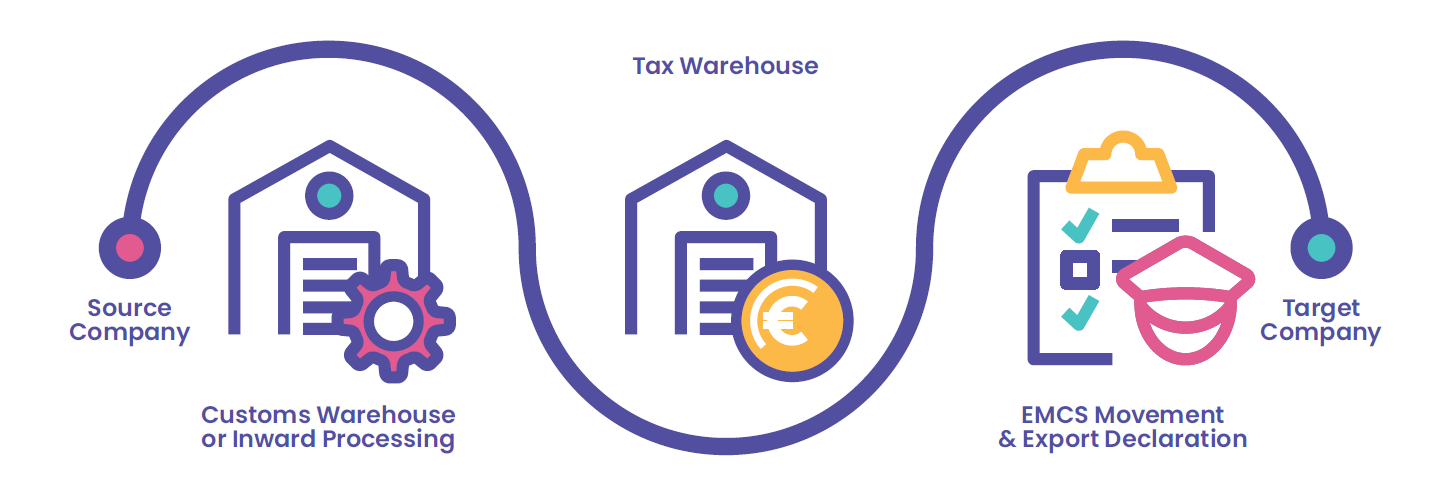
In bulk operations, a shipment rarely follows a single customs procedure from start to finish. A cargo might arrive under transit, be imported into a customs warehouse where it is held duty-free, then transferred into a tax warehouse where excise suspension applies, and finally exported with an EMCS movement and an export declaration. Each of these steps is a separate customs act with its own submission, its own response from the customs authority, and its own deadline. Coordinating them manually, or across disconnected systems, creates significant risk of error and delay.

2. Excise movements come with strict message obligations and tight deadlines

Goods moving under excise duty suspension, such as LNG, Gasoil and other oil derivatives, FAME, Ethane and certain additives, must be accompanied by an electronic administrative document submitted through the EMCS system. Once the goods arrive, the consignee has five working days to confirm receipt. During transport, if the destination changes, the document must be updated. If goods are lost or short-delivered, that shortage has to be reported and explained. All of this involves specific message types that must be submitted in the right format, in the right sequence, within the regulatory deadline. Missing a deadline, or submitting the wrong message type, can result in the duty suspension being lost and excise duty becoming immediately chargeable.

3. Managing the link between excise movements and export declarations manually is a risk

Bulk exporters often use simplified export procedures: a simplified declaration is submitted before departure, and a supplementary declaration follows. When the shipment also involves an EMCS movement, the excise system issues an administrative reference code (ARC) that must appear on the export declaration. In practice this means the export system and the excise system need to exchange data automatically. If that linkage is manual, it creates a bottleneck on every shipment. Beyond the ARC linkage, keeping declarations current throughout a shipment is a challenge in itself. Small changes, such as a quantity update or an EMCS confirmation, should not require a formal amendment. And customs need to be notified when a movement is starting so they can monitor it. In practice this means the customs system needs to handle incremental updates intelligently.

4. Bulk inventory is never static, and the numbers are never simple

Bulk liquid goods can be blended before they even reach the terminal. Once ashore, blending continues at the facility itself. The volumes received are not always identical to the volumes that leave, due to blending, temperature differences, or natural loss during transport. Then there are pipelines that drip continuously, meaning inventory is in constant motion and stock figures need to be updated in near real time to remain accurate. On top of that, a single tank can hold goods with different customs statuses at the same time: Union goods and non-Union goods co-mingled in one physical vessel. Each of those goods has different obligations, different procedures, and a different point at which duty becomes chargeable. Tracking all of this accurately, at the level of individual product categories and customs regimes, requires more than a standard inventory system. EU regulations set specific partial loss thresholds per product type, and tolerances are variable per country and flow. Exceeding these thresholds triggers a formal shortage report.

5. Tax warehouse operations require real-time duty position visibility

Goods held in a tax warehouse are under excise duty suspension, meaning duty is not yet chargeable. The moment goods leave that suspension, duty becomes chargeable. You need to know at any point in time which goods are in suspension, which have been released, and what the resulting duty position is. You also have to file mandatory reports with the national authority, including excise stock balances and petroleum balance reports on a monthly, quarterly, and annual basis.

6. Transit declarations add their own layer of procedure and guarantee management

Many bulk shipments arrive or depart under transit, either as a standalone transit movement or combined with an import or export declaration or an EMCS movement. Transit requires its own message exchange with the NCTS system and its own financial guarantee. Where multiple representatives are authorised on a single guarantee, each needs to be registered with the customs authority. Managing this alongside the rest of the customs chain adds complexity that standard customs tools rarely handle in a combined flow.

7. System outages cannot be allowed to stop operations

Bulk terminals operate continuously. When a national customs system is unavailable, you still need to be able to dispatch goods, particularly for excise movements where a delay in starting a movement can have commercial consequences. Procedures exist in EU law to allow movements to start on paper during an outage, but these need to be managed carefully and reconciled once the system is restored. Additionally, when declarations get stuck following an outage, they need to be resolved without losing the stock position or the compliance record.

8. Customs data has to flow in and out of existing terminal and ERP systems

You manage your shipments in WMS, terminal management systems or ERP platforms. Customs declarations cannot be managed in isolation from these systems. The customs software needs to receive shipment data from your system, apply the correct customs logic, submit declarations, and send status updates back, all without requiring manual re-entry of data. Where a shipment is updated in your system, those changes need to flow through to the relevant declarations automatically.

How CAS addresses these challenges

The challenges above are not edge cases. They are the day-to-day reality of bulk customs operations, and they require a platform that is built to handle them, not one that has been stretched to fit. CAS handles the full complexity of bulk customs and excise flows out of the box, including every one of the challenges described.

CAS connects individual declaration steps into a single end-to-end chain. A shipment that arrives under transit, moves into a customs warehouse or inward processing, transfers to a tax warehouse, and departs under an EMCS movement with a linked export declaration is handled as one connected flow. The output of each step feeds automatically into the next. There is no manual handover between procedures, and these multi-step chains are already running in production with bulk operators today.

Bulk sector

How it works

Each step in the customs process, such as a transit declaration, an import declaration, or an EMCS e-AD, is managed as a separate customs flow step within CAS. These steps are linked together so that the output of one step automatically feeds into the next.

C4T-Tier2 Icon-Compliance

1. You submit the shipment

• You send your shipment data to CAS via the API.
• CAS uses configurable rules to determine which customs procedures apply and in what order.
• CAS creates the corresponding chain of declaration steps for that shipment.

C4T-Tier2 Icon-Reports

2. CAS processes each declaration

• Each declaration step is submitted to the relevant customs system in the respective country.
• Responses from the customs authority, such as acceptance confirmations and the ARC for an EMCS movement, are received by CAS and automatically passed to the next step that needs them.
• Your system is notified of status changes via the API.
C4T-Tier2 Icon-Data Quality

3. Stock and excise positions are updated

• Every import into a customs warehouse or tax warehouse, every blend, and every removal is recorded in CAS and linked to the underlying declaration.
• Loss thresholds are checked automatically. Shortages within the allowed tolerance are handled without requiring a report; shortages above the threshold trigger the relevant EMCS message.

C4T-Tier2 Icon-Dashboard

4. Reports and audit trail

• CAS maintains a full record of every declaration, every message exchanged with the customs system, and every stock movement.
• Regulatory reports such as excise ledgers, stock balance report, and petroleum balance reports for Belgium are generated from this data.

Features you'll love

Full EMCS lifecycle

For excise movements, CAS handles the full EMCS lifecycle: submitting the e-AD, receiving the ARC, processing reports of receipt, managing cancellations, changes of destination, and shortage or delay notifications. Prefiltered work lists ensure the right actions are surfaced to the right people at the right time, and follow-up notifications to the receiving party are triggered automatically so that nothing depends on manual chasing. Every movement is tracked against its regulatory deadline. Where a shipment also requires an export declaration, CAS links it to the EMCS movement automatically as soon as the ARC is issued. With CAS, you simply resend your updated shipment data and CAS takes care of the rest, applying only what has changed and notifying customs accordingly.

Real-time stock tracking

Stock is tracked in real time at both customs warehouse and tax warehouse level, including blended quantities and the distinction between Union goods, excise duty paid goods, and goods moving under excise duty suspension. Loss thresholds are configured per product category, shortages within tolerance are handled automatically, and the duty position is always current. Stock picking optimisation ensures that the right stock is selected for each movement based on its customs and excise status. Regulatory reports are generated directly from CAS data.

Business continuity

When a customs system goes down, a business continuity fallback keeps operations running and reconciles everything on recovery. CAS supports business continuity procedures, allowing both customs declarations and excise movements to continue during an outage and reconciling them automatically once the system is restored. Declarations that get stuck in the process are resolved without losing the stock position or the compliance records.

API integration

CAS connects to your ERP, TMS, middleware or WMS via an API. Your system sends the shipment data; CAS applies the correct customs logic, submits the declarations, and pushes status updates back automatically.

Benefits

C4T-Tier2 Icon-Multi Country 1

One platform for the full chain

Imports, customs warehousing, tax warehousing, EMCS movements, and exports are all handled in CAS. There is no need to manage separate systems for each procedure or manually transfer data between them.

C4T-Tier2 Icon-Onboarding-Cerise-SMALL

Faster releases, fewer manual steps

CAS links declaration steps automatically so goods can be released in minutes rather than hours. Transit arrivals, import acceptances, and EMCS approvals feed directly into the next step without waiting for manual input. When quantities are updated after loading or unloading, you resend the data and CAS applies only what has changed. No amendments, no manual rework, no delay.

C4T-Tier2 Icon-Clearance & Compliance

Full excise compliance

The full EMCS message set is supported: reports of receipt, cancellations, changes of destination, shortage responses, and delay notifications. Deadlines are tracked per movement, so nothing slips through. On the tax warehouse side, CAS manages the complete stock lifecycle, from initial loading and blending through to removal under suspension. Losses, overages, and density changes are recorded and handled within the configured thresholds, with the duty position updated in real time at every step.

C4T-Tier2 Icon-Validation

Stock positions you can rely on

Your customs warehouse and tax warehouse stock is updated in real time with every movement, blend, and removal. Loss thresholds are configured per excise product category in line with EU rules. Losses within tolerance are handled automatically; losses above threshold are flagged. CAS converts units of measurement between authorisations, using density to translate between the unit applicable under a customs warehouse and the unit applicable under a tax warehouse. 

C4T-Tier2 Icon-Dashboard

Regulatory reports, always ready

Excise stock balance reports and petroleum balance reports at monthly, quarterly, and annual frequency are generated directly from CAS. No manual compilation, no reconciliation between systems, and no risk of errors in submissions to the national authority.

C4T-Tier2 Icon-Border Delays2

Resilience when systems go down

A business continuity fallback allows EMCS movements and customs declarations to start on paper when the customs system is unavailable and reconciles them on recovery. Stuck declarations are resolved through a structured remediation process. Your operations and compliance record stay intact.

Bulk complexity covered

CAS handles the full complexity of bulk customs and excise flows out of the box.